
By Michael Mander
What does Bedford have in common with Orlando, Hollywood, Beijing, and Osaka?
The answer: not very much – right now. But soon, Bedford could join these locations as the home of a Universal Studios theme park.
In December, Orlando Park Stop compiled a raft of evidence that suggested Universal was mulling a British theme park.
Universal had quietly acquired almost 500 acres of land in Bedford – spending almost a quarter of a billion dollars in the process.
A day later, Universal confirmed it was “exploring” a potential park in the town. Cue a frenzied response on social media, in the newspapers and on the theme park forums.
But British theme park fans will no doubt feel a twinge of déjà vu.
‘British Disneyland’
12 years ago, theme park designer Tony Sefton announced his ambition to bring a large-scale theme park to the UK, with the backing of another Hollywood film studio.
Paramount London was dubbed the “British Disneyland” by the newspapers, and promised to bring with it the glitz of Hollywood – plus thousands of jobs, tourists and an economic boom to the local area.
But in March last year, its developers – London Resort Company Holdings – called in the Administrators faced with a mountain of debt.
Former partners Paramount sued them in November. Their primary funder, Dr. Abdulla Al-Humaidi, declared bankruptcy around the same time.

The project’s chairman, Steve Norries, insists this isn’t the end. But fourteen years on, there’s still nothing but a marshy patch of land in Kent where a theme park had once been promised.
So can Universal succeed where the London Resort failed?
There are plenty of reasons to be sceptical. The UK’s complex planning system makes large-scale projects more than a little tricky.
Inbound tourism still hasn’t recovered from the pandemic. And our unpredictable weather and long, cold winters make operating rollercoasters a strictly seasonal business.
But there’s also several reasons to be optimistic because Universal, after all, is not like the London Resort in many ways. Here’s just a few key differences that could be in Universal’s favour.
1. Universal has a track record of success
In 2004, a Paramount executive stood alongside local developers in Osaka, Japan, and announced a huge Paramount Movie Studio theme park.
But nothing came to fruition.
In 2007, Paramount signed a deal with a Middle Eastern real estate company to build a Paramount Park in Dubai.
But nothing came to fruition.
In 2008, Paramount Movie Park Korea was announced: a $1.5 billion theme park project in Incheon, South Korea.
But nothing came to fruition.

And in September 2010, Paramount’s licensing arm announced it had entered agreements for the development of a theme park in Murcia, Spain.
You guessed it – it never came to fruition.
Paramount was not the developer of any of these theme parks, but they did licence their name and their films to the projects – just as they did with the London Resort.
You’d be forgiven for thinking that a licensing deal with Paramount is a kiss of death for a fledgling theme park.
There is no Paramount theme park in the world today. Universal, on the other hand, has five.

Universal Destinations & Experiences is the third largest operator of amusement parks in the world – welcoming tens of millions of guests and raking in billions of dollars in revenue.
Universal, like Paramount, bring some baggage. In the 90s they purchased land in Europe for a potential competitor to Disney’s EuroDisney.
They’ve also abandoned projects at various stages of development in Russia, UAE, South Korea and Germany.
But we know that Universal can build a theme park. In fact, they can do it quickly: the in-progress Epic Universe is shooting up faster than many other theme parks can finish a paint job.
2. Universal is not at the mercy of money men
Universal’s parent company Comcast is doing well. Their most recently posted earnings showed strong growth of 2.3%, exceeding expectations.
But their theme parks are doing really well: a record-breaking quarter with revenues up 12.2%. Theme parks are money making machines for Comcast.
It’s no wonder, then, that they want more: the Epic Universe theme park will represent a huge investment, along with new park concepts under development in Las Vegas and Texas.
Thanks to their bumper operating revenues, Universal has access to the cash they need to get these developments off the ground.
The London Resort developers did not have that luxury. Without capital of their own, they needed to raise funds from investors. That brings with it problems.
The first is that investors can be unreliable. In 2015, it was announced that the London Paramount project would receive an impressive £100 million investment from the Chinese firm, SinoFortone.

But this promise of funds was “all bollocks”, as SinoFortone’s co-director would later put it. They didn’t have the money to back their investment.
Second, investors can pull out. In October 2018, construction engineering company Keltbray announced their intention to invest £25m into the London Paramount project – by this point called the London Resort.
RideRater revealed in 2020 that Keltbray had ended that partnership, with no comment on when or why.
And third, investors don’t always make things easier. The lead investor bankrolling London Resort Company Holdings was the Kuwaiti businessman Dr. Abdulla Al-Humaidi.
He had lingering bad press from his ownership of Ebbsfleet United, where he was forced in 2019 to deny allegations that he had deceived players after they claimed their salaries were delayed.
The same fate befell the bosses at London Resort Company Holdings. Chairman Steve Norries told Kent Online: “When the first oil price collapse happened those funds from Kuwait dried up.
Ever since, funds have arrived intermittently and in insufficient volume.”
3. Universal is managing the hype
If you’re dependent on investor bucks, then you have to get the word out and raise some hype.
The London Resort plastered their plans across social media and the newspapers before they’d so much as secured the land.
But hype can be a poisoned chalice. When you make big promises, you give the public high expectations and you open the door to big opposition.
For the London Resort, hype was part of their undoing.

Proving their worth to investors meant securing government backing in the form of a special designation as an NSIP: a Nationally Significant Infrastructure Project.
This gave them the power, if needed, to begin compulsory purchases of land.
This attracted a raft of negative reaction. In 2015, the Peninsula Management Group was formed to represent the 140 businesses that are located in the proposed area of the London Resort.
Employing up to 1,500 people, the group says that many of those jobs will be lost if they are forced to relocate by Compulsory Acquisition orders.
This group repeatedly made clear their firm opposition to any plans that would leave their businesses worse off.
Jumping spiders
And, of course, what ultimately proved to be the downfall of the London Resort: jumping spiders.
Following all of the awareness the London Resort developers brought to the area, and following campaigns from environmentalists, Natural England designated the proposed area a Site of Special Scientific Interest (SSSI) – in part due to the presence of a rare breed of jumping spider.
Universal, on the other hand, is managing expectations. Just look at the language on their dedicated site: they are “in the very early stages of exploring the possibility of a potential park” – exploring the possibility of a potential: you couldn’t hedge that more if you tried!
Unlike the London Resort, we have no glossy promotional pictures or promises of specific roller coasters and rides.
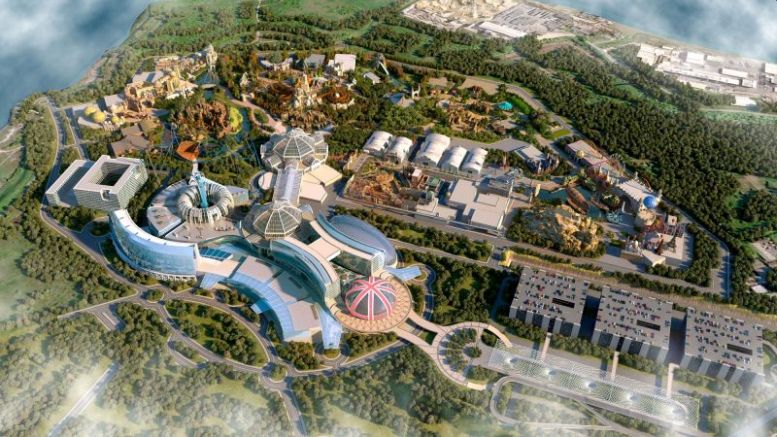
All of these caveats won’t do much to contain the excitement of enthusiasts, but it does help keep things in check.
If Universal decides to proceed with a smaller project in lieu of a theme park – like the Universal Kids Resort they are currently building in Texas – that option remains open to them.
And if they decide not to proceed, their reputation remains intact for future developments; retaining the goodwill of local people in the way the London Resort has not.
Universal are not making any promises – although in less than a year they are already leaps and bounds ahead of the London Resort in one major aspect.
4. Universal already own the land
It beggars belief that after 14 years, and with tens of millions of pounds spent, London Resort Company Holdings bought just 18 acres of land.
That’s about 2% of what they’d need to bring the Kent project to life.
Universal, on the other hand, has bought 480 acres of land: more than Legoland Windsor and Chessington World of Adventures combined.
It’s enough to comfortably fit a theme park, even if a Florida-style resort might be a bit of a squeeze.
Owning the land of course provides nothing close to certainty that the project will go ahead. After all, they’ve bought land for later-scrapped projects before.
But it’s certainly a step in the right direction, and it demonstrates the seriousness – and financial might – behind Universal’s ideas.
Whether the plans progress remains to be seen. It will be, they say, “many months” before we get an update – and Universal certainly has its fair share of obstacles to overcome.
They might be scuppered by upset locals or campaigning environmentalists. Or they may just decide that Bedford won’t attract the numbers they need for a profitable endeavour.
But their strong front foot gives me reason to be hopeful. After all, we’re long overdue for a new theme park: The UK has built just two new theme parks in the 21st century.
Universal is very welcome to make it three.