

1935 saw two distinctive attractions arrive at Blackpool Pleasure Beach: the infamous Laughing Man, and one of the world’s most iconic rollercoasters.
And while the creepy Laughing Man was inspired by park owner Leonard Thompson’s trip to France, the Grand National was a continuation of the American inspiration that gave birth to the Pleasure Beach itself some four decades prior.
After its delayed re-opening this season following maintenance works, the Grand National remains a classic, cross-generational draw.
Conceived as a tribute to the twin-track coasters of Coney Island, it is a Möbius loop wooden racer design.
While it was inspired by Americana, its name is uniquely British in its tribute to Liverpool’s famous annual horse race.
Innovative design
The Möbius loop is a design that still interests all that think about such things.
Riders board one of two trains and finish on the opposite side, creating a continuous, intertwined race across one single piece of track – not two, as it appears.
The Grand National remains one of only two Möbius loop coasters in the world, celebrated for its classic wooden design, and family-friendly yet still white-knuckle experience.

When it opened in 1935, it replaced Pleasure Beach’s then-famous Scenic Railway. It immediately became the park’s largest rollercoaster by a huge margin.
The ride was designed by American engineer Charles Paige, with track engineering input from Henry G. Traver.
It has retained popularity and affection among the public ever since, by both the very young and very old.
Fire and fatality
The Grand National station’s architect Joseph Emberton died in 1956, but much of his work remains at Blackpool Pleasure Beach to the present day.
That same year, a 14-year-old girl died when she fell from the ride.
This type of sad event was not unheard of in the early half-century of wooden rollercoasters, which typically had no restraints.
Fire has also been a threat to wooden rides over the years, and the Grand National is no exception.
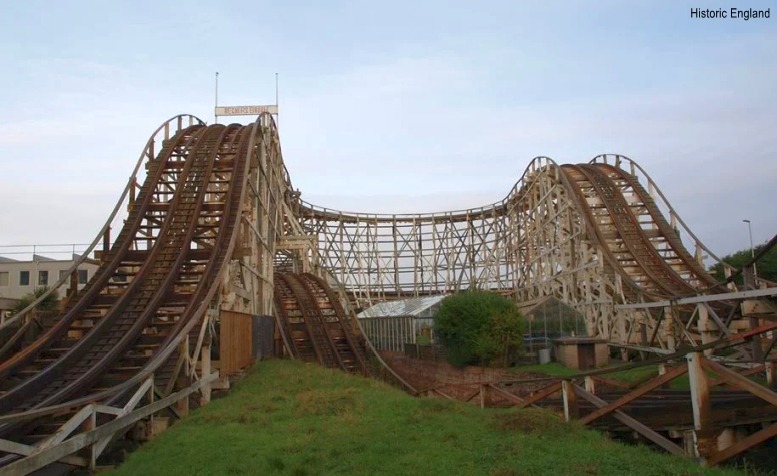
1980 saw the ride’s motor house experience a damaging blaze, and a later fire also damaged its station building.
A £1 million private sector investment in 1990 paid for a full station rebuild and major timber repairs, preserving the rollercoaster’s classic character into the modern era.
In 1992, Andy Hine, chairman of the Roller Coaster Club of Great Britain, married aboard the ride, which retains a plaque bearing his name on one of the trains.
Ongoing commitment
The station’s original concrete and glass art deco pavilion, designed by Emberton, was lost in a 2004 fire, but rebuilt later that year at great cost and effort.
The ride reopened the following year, with new trains.
The Grand National was a made a Grade II listed structure in 2017, although there remain occasional rumours the park wishes to demolish the ride.
The Twentieth Century Society has placed it on a “Buildings at Risk” list, urging public and planning authorities to safeguard this ride as living heritage.
Despite this, fortunately there is no hard evidence that this historic ride is under any kind of imminent threat.
In fact, the Pleasure Beach’s commitment – even if forced to some degree – to the ride, should ensure it brings joy to a future generation of thrillseekers.